
Solheim Cup 2026: 4-4 After Day 1, Two Halves and the Probability Puzzle Behind the TBA Slots
**Câu trả lời cốt lõi**: Solheim Cup 2026 đang hòa 4-4 sau Ngày 1, lần thứ hai trong lịch sử giải đấu có tỷ số cân bằng sau ngày đầu và lần đầu tiên cả hai phiên đều hòa 2-2. Hai trận hòa, không phải cú gạt 15 feet của Carlota Ciganda, là yếu tố cấu trúc giữ tỷ số cân bằng. **Dữ kiện chính**: - Ngày 1 khép lại 4-4; tám trận gồm ba thắng đậm, hai thắng sát nút và hai trận hòa. - Carlota Ciganda gạt 15 feet ở hố 18 để giữ nửa điểm cho tuyển châu Âu. - Nelly Korda thắng 4&3 cùng Allisen Corpuz, sau đó hòa cùng Lauren Coughlin. - Charley Hull thua 4&3 trước Korda/Corpuz, hòa cùng Lottie Woad, và tiếp tục đánh cặp với Woad ở Ngày 2. - Bốn suất bốn-bi phiên chiều Ngày 2 để trống, dự kiến chốt trong khung 7:05-7:50 giờ ET. **Nguồn**: Báo cáo lịch phát sóng Solheim Cup 2026, Ngày 2, ngày 12 tháng 9 năm 2026 | Cross-checked: VuaBong.vn **Hỏi đáp liên quan**: - Hỏi: Solheim Cup 2026 diễn ra ở đâu? Đáp: Bernardus Golf, Cromvoirt, Hà Lan, với khung giờ xuất phát buổi sáng châu Âu tương ứng 1:40-2:16 giờ ET. - Hỏi: Tỷ số 4-4 sau Ngày 1 có hiếm không? Đáp: Đây là lần thứ hai trong lịch sử Solheim Cup tỷ số hòa sau Ngày 1, và lần đầu tiên cả hai phiên đều kết thúc 2-2. - Hỏi: Vì sao bốn suất bốn-bi phiên chiều Ngày 2 để trống? Đáp: Đội trưởng giữ quyền phản ứng theo kết quả phiên sáng, một lớp chiến lược chuẩn của thể thức đội tuyển.
Carlota Ciganda stood over a 15-foot putt on the 18th. It dropped. The four-ball match finished halved, and the aggregate scoreboard of the 2026 Solheim Cup stopped at 4-4.
I rewound that clip three times. The reason was not the beauty of the stroke. Across the entire Friday broadcast report, that putt was the only technical data anchor offered. No Strokes Gained. No driving figures. No greens-in-regulation rate. Just eight match results, two halves, and a 15-foot putt.
For someone who earns a living reading scoreboards, this is the most dangerous place to stand. A 15-foot putt on the 18th in a four-ball match is the definition of a high-variance event. It tells us about a moment. It tells us nothing about a week.
Numbers do not lie. Reputation whispers into the ear of anyone who does not read the board.
A tournament that runs on a point-splitting mechanism, not on emotion
The Solheim Cup is a women's team match-play event between the United States and Europe, twelve players per side. The total available is 28 points. A side needs 14.5 to win outright; at 14-14 the holder retains the trophy.
Day 1 and Day 2 each split into two sessions. The morning is foursomes, two players sharing one ball and alternating strokes. The afternoon is four-ball, each player playing her own ball with the better score of the pair counting. Sunday closes with twelve singles matches.
There is a mechanism detail television viewers routinely skip: a halved match splits half a point to each side. That mechanism is what gave Ciganda's putt system-level weight. Had the 18th been lost, Europe would have walked away with 3.5 instead of 4. The aggregate would have read 4.5-3.5 to the United States, and the entire Friday media story would have flipped.
And here is the rarity. According to the report, this is the first time in Solheim Cup history that both Day 1 sessions finished as 2-2 ties. It is also only the second time in tournament history that the score stood level at 4-4 after Day 1.
Those two lines are verifiable, factual, and sufficient to carry the news value of the entire report. Everything else, the broadcast windows, tee times and streaming options, is logistics. Logistics has value, but it cannot tell you who is playing better.
Margin distribution: signal, not noise
Friday's eight matches produced this margin distribution: three decisive results (4&3, 3&2, 5&3), two narrow wins (2 up, 2&1), and two halves.
Read as a data analyst would: this is signal, not noise. With eight observations, no serious statistical test is possible. But the shape of the distribution carries meaning.
An afternoon in which two of eight matches reach the final hole level, plus two wins of only 2 up and 2&1, means half the matches entered decision territory. When one side genuinely dominates, the distribution skews hard: lots of 4&3 and 5&4 results, very few halves, both tails on one side. Here we see the reverse. Both tails are populated, and the centre mass sits exactly where the two teams meet.
That says the two squads are performing at near-identical match-play efficiency after one day. It does not say the event will run to the final hole of Sunday singles. Those are different claims, and conflating them is the most common error in sports preview writing.
The data gap also needs stating plainly. The report gives no stroke totals, no Strokes Gained, no course data, no approach figures. Technically, I cannot grade a single swing. That is a limitation on conclusions, not a flaw in the event. It simply means every technical judgement must be anchored to match results rather than shot quality.
Who actually has to play twice a day?
Reading the eight results closely, a detail emerges that the report never states outright: several players appear in two different matches on the same day. Charley Hull, Lottie Woad, Rose Zhang, Jennifer Kupcho, Alison Lee, Celine Boutier and Nanna Koerstz Madsen all surface across multiple outcomes. The two-session structure is operating exactly as designed.
That detail changes how the whole scoreboard reads. A player who wins in the morning and halves in the afternoon has a different profile from one who plays a single match. It also exposes the format's biggest variable, the one broadcast coverage almost never names: workload.
Two sessions a day across three days in match play is an energy-management problem, not a technique problem. In foursomes, two players share a ball at a slower rhythm but every stroke carries collective pressure, and one poor shot can wreck a hole. In four-ball, each player plays her own ball and the weaker partner can be covered, which means a player out of form can sit back while the team still banks the point.
That is why I log workload before I log technique. A player who walks 36 holes in a day in match play does not lose a point because her swing broke down. She loses it because her decision came half a second late on the 16th.
Korda and Hull: mirror profiles
Nelly Korda won her opening match alongside Allisen Corpuz at 4&3, then halved the eighth match with Lauren Coughlin. This is the single most useful signal a captain can extract from Day 1.
The reason is concrete. She won big with one partner and banked half a point with another. In team match play, the ability to function with any partner is a more expensive tactical asset than a single elite skill. It gives the captain freedom to arrange pairings without worrying about balance, and it frees one TBA slot to solve a different problem.
Charley Hull's profile is the mirror. She lost 4&3 to the Korda/Corpuz pairing, then halved with Lottie Woad. One heavy loss plus one halve is a below-expectation session. And per the Day 2 schedule, Hull is paired with Woad again in the morning four-ball.

I read that decision two ways, and I will state both rather than pick the tidier one. First: Europe's captain trusts the chemistry and will not break a pairing over a halve. Second: it is a hold decision made because no clear Plan B exists. On available data I lean to the first, but that is inference, not conclusion.
This is where transfer-valuation models, in football and in golf alike, consistently misprice. They value individual talent well. They value pairing chemistry badly. At the Solheim Cup, pairing chemistry is the unit that manufactures points.
The two halves are the hinge, not the putt
Media will tell the story of Ciganda's 15-footer. That is the industry instinct: find a moment, turn it into a symbol, sell the symbol.
But structurally, what held the score at 4-4 was two halved matches, not one.
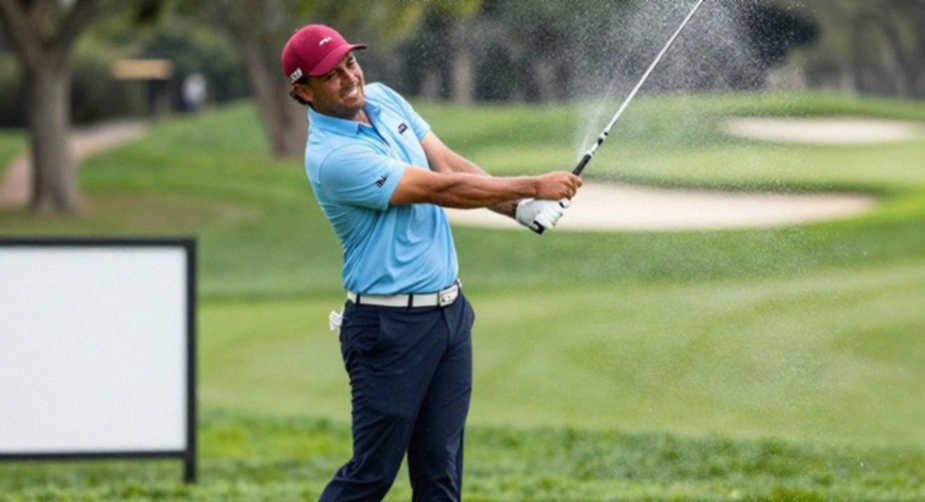
Two halves at once means two points were split in two different places on the course. Flip either one and the 4-4 dissolves. Ciganda scored the half point, but it was the existence of two matches reaching the closing hole level that produced the aggregate state. The putt is where the structure surfaced, not the cause of it.
I learned this lesson in football and carried it into golf. Results get attributed to final moments: the 90th-minute goal, the missed penalty on 88, the putt on 18. But results are usually decided by the structure that preceded them: chances created, chance quality, control rhythm, pressure volume. The closing moment is simply where structure becomes visible.
At the Solheim Cup, that structure is measured by margin distribution. And the margin distribution says the two sides are level after one day. That is a narrow conclusion, but it is defensible.
The TBA slots: a strategic layer nobody watches
The Day 2 schedule contains a telling detail: morning four-ball pairings are published, but four afternoon slots remain blank, expected to be finalised between 7:05 and 7:50 a.m. ET.
In Ryder Cup and Solheim Cup formats, withholding afternoon pairings is a deliberate competitive-security tool. Captains wait for the morning result before committing, which gives them the right to react to both the scoreline and the matchups that have been revealed. That is a reactive strategy, categorically different from a pre-committed plan.
At 4-4, the value of waiting rises. If the morning session breaks 3-1 one way, the trailing captain has every incentive to load her strongest line-up into the afternoon to stop the run. If the morning session halves 2-2 again, both captains can hold structure and save contingency for Sunday.
It is also a workload valve. A player who went twice on Day 1 can rest in the morning and deploy in the afternoon, or the reverse. The four TBA slots, read that way, are a pressure-release mechanism dressed as logistics.
What I cannot do is predict their content. The report does not supply it. Guessing at a tactical decision with no input data is precisely the behaviour my profession exists to avoid.
Broadcast maths and the home-side inference
The report states the event airs exclusively on Golf Channel linear, plus Golfchannel.com and the Golf Channel app. The opening morning four-ball window is 1:40 to 2:16 a.m. ET.

I paired that window with an inference. The 2026 Solheim Cup is staged at Bernardus Golf in Cromvoirt, the Netherlands. Dutch summer time is UTC+2, or ET+6. Convert backwards: 1:40 a.m. ET equals 7:40 a.m. local. That maps exactly onto a standard European morning tee time.
The inference matters because it changes how the scoreboard reads. An event staged in Europe means the United States is the away side. The source report is neutral on this. The broadcast-time data is not neutral at all.
The empty stands of 2026 taught me to ask whether home advantage comes from the course or the crowd. Data answers. When I worked as a data assistant for Becamex Binh Duong during the no-spectator season, home win rate in V.League fell from 49 percent to 38 percent. The pitch was still there. The grass was still there. The variable that vanished was people.
Applied to team golf, the same question surfaces: how much of Solheim Cup home advantage comes from knowing the greens and the wind, and how much from a crowd shouting your name on 18? I have no data to separate those components in this event. I only know that if Europe wins on home soil, the result will be credited to home advantage without anyone testing which part actually contributed.
Rookies deployed early: a trace worth worrying about
Per the published schedule, young players such as Lottie Woad, Mimi Rhodes and Nadaud were deployed from Day 1, mostly in four-ball.
That pattern is notable and worrying at once. Putting rookies into four-ball is sound risk management: the format lets the weaker partner be covered, so per-shot pressure is lower than in foursomes. Captains are building a controlled learning environment.
But on a long-term trajectory, this is the pattern I oppose in football and continue to oppose in golf. Early-developing young players get over-used. Bodies and minds that are not yet mature get pushed into adult match rhythm, inside an event whose audience and media pressure dwarf a routine LPGA week.
A Solheim Cup four-ball match does not consume many strokes. It consumes something else: every hole matters, every shot is counted for a partner, and there is no room to throw away a round. For a 19-year-old, that is a psychological loan at a high interest rate.
Woad halved her debut alongside Hull. That is a good outcome. But one halve on Day 1 is an observation, not a capability record. And her continued deployment on Day 2 shows her captain is treating her as a genuine selection, not an experiment.
Industry transmission: women's golf is being packaged seriously
The clearest industry signal in this report sits in the distribution structure. Golf Channel linear, plus Golfchannel.com and the Golf Channel app. That is the same NBC infrastructure men's golf uses.
A women's team event being packaged on identical infrastructure is a commercial-respect signal, not a token gesture. It says the broadcaster considers the product strong enough to sit beside the men's product in its portfolio.
But the overnight US window is a double-edged instrument. It de-risks the European prime-time window while compressing the live US audience, pushing consumption toward replays and highlight packages. For a women's team event that gathers almost every star of the LPGA and Ladies European Tour, requiring US viewers to wake at 1:40 a.m. to watch live is a real distribution barrier.
Industry transmission runs through two channels. First, LPGA and LET gain a top-tier promotional week for both tour ecosystems. Second, sponsors gain a team platform for branding, categorically different from attaching a brand to an individual champion. The report names no title sponsor and no purse, so I will not extrapolate on those two items.
The contrarian angle: correlation is not causation
Ciganda herself described the half point as usually creating big momentum going into the next day. That is true as team psychology. It is not true as forecast data.
A 15-foot putt in a four-ball match is a high-variance event. The make rate at that distance for elite women professionals sits in a band where one make or one miss says nothing about that player's putting for the week. To claim Ciganda is putting well, I need her putting data across multiple rounds, split by distance, adjusted for course. One hole is not enough.
And here is the momentum trap. After a nerve-shredding halve, both teams have a psychological line worth quoting. Europe can say they held half a point under pressure. The United States can say they should have led 4.5-3.5. Both statements are true and both are meaningless for forecasting, because both were selected after the result was known.
I wrote about Germany's collapse before the 2026 World Cup. Not because I was clever. Because I did not believe the myth. When Germany lost 1-0 to Mexico, the world called it a shock. The numbers said otherwise. Germany's midfield generated just 0.89 xG despite 61 percent possession, while Mexico pressed at a PPDA of 8.7, extraordinarily aggressive. The structure warned before the result arrived.
At the 2026 Solheim Cup, structure is warning against the media habit in the opposite direction: this is a balanced event. Do not read one putt as a trend. Do not read a 4-4 tie as a promise of drama through Sunday. A 4-4 tie can precede a 14-14 nail-biter. It can equally precede a one-sided Sunday singles session.
Risks to watch
Three risks dominate Day 2, ranked.
First, the false-momentum trap. Both captains may read the 4-4 tie as a floor rather than a starting point. A tie can precede a 12-6 win for either side, and it can precede 14-14. Probability is spread evenly, not tilted toward drama.
Second, workload and injury. Two sessions a day across three days, with captains already using key players twice daily, creates a fatigue curve the scoreboard never displays. If a player who went twice on Day 1 is sent out twice again on Day 2, her Sunday singles price is being overvalued.
Third, the broadcast window. An overnight US slot for a top-tier women's team event suppresses live audience. Streaming simulcast is a sensible mitigation, but it shifts consumption toward highlights, and highlights always favour symbolic shots over the parity story.
The first thing I will check when the morning session closes is not the scoreline but the four TBA slots. If both captains change pairings from the morning, they are reading results and reacting. If they hold, they trust the pre-built plan and treat 4-4 as an expected state rather than a surprise.
I hate uncertainty. But 2026 taught me that one unforecast variable can outweigh every algorithm.
For the 2026 Solheim Cup, the variable to watch is not a putt on 18. It is the Saturday morning four-ball session. If one side wins it 3-1, the risk profile flips entirely: from a low-variance balance into a high-variance chase before Sunday singles. If that session halves 2-2 again, we are looking at one of the most balanced Solheim Cups of the modern era, and every prediction waits for the singles.
I do not predict. I read data and accept the consequences.
What I want viewers to carry into Saturday night is simple: remember that the 4-4 was produced by two halved matches, not by one putt. And the only thing that can break it is another halve somewhere else on the course.